Camera Gear That I Use
I’m actually writing this somewhat hesitantly, as I’m not really someone who enjoys talking about camera gear too much. In fact, sometimes I find it a bit frustrating when people ask me what camera I use, because there’s occasionally a somewhat tacit suggestion in the question that the camera is the reason why a photo or video is good, and not because the person handling the gear knows what they’re doing with it.
Buying an expensive camera won’t make you a good photographer; being a good photographer is about understanding photography.
You can take great photos and shoot great videos with any camera. This is because photos and video are about so much more than pixels or camera settings and whatnot, they’re about great moments, beautiful lighting, strong composition, and how these things come together to tell a story. And because of that, I generally avoid being drawn into discussions about cameras and camera gear, because my motto is generally “the best camera is the one you have with you at the time”.
But of course, there’s no getting around the fact that different types of cameras do open up a bit more creative flexibility, even though it could also be argued that sometimes the most creativity comes from working within very significant limitations.
So while I don’t generally talk much about my cameras, I realise that in the sphere of outdoor adventures, camera gear is an interesting topic because when we’re trying to keep weight and bulk down, it sort of narrows our options somewhat.
Like many YouTubers, I originally tried shooting videos with a GoPro. I almost instantly disliked it though, and even though I use them extensively in my kayaking videos, this out of pure necessity due to the environment in which I am using them. I am constantly frustrated by their nature, and that’s because of my background.
I actually come from quite a long background in photography, albeit in a world really far removed from the relaxing world of hiking and kayaking: music photography (link to my Instagram). I’ve shot for music magazines and music festivals since 2012, mostly within the world of rock and heavy metal, shooting everyone from Iron Maiden to Marilyn Manson to Rammstein to Korn and Limp Bizkit on stages across London to the big summer stages of Download Festival and others.
With most magazine work having dried up since the pandemic, I still very occasionally shoot gigs, and shoot a big metal festival in England every summer, but other than that I don’t really do much in the way of professional photography anymore. I’ve never been a good landscape or nature photographer. My speciality has always been getting great moments of rock stars strutting around on stages, focusing on energy and expression.
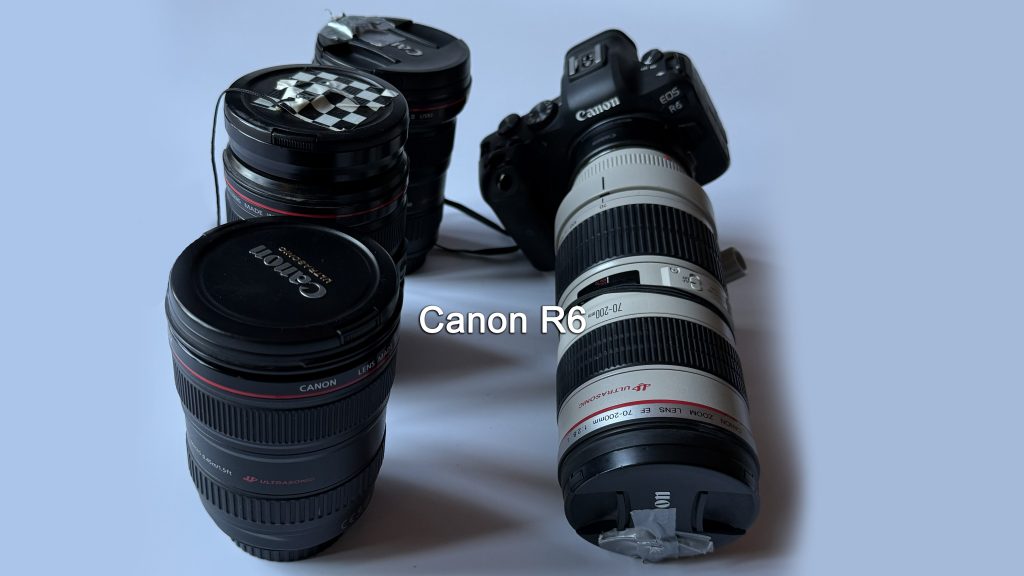
For this work I have always shot with full frame Canon bodies and Canon L series lenses. The problem is this gear is quite heavy, and very expensive; it’s risky taking it into the outdoors, especially kayaking trips. I do know a few people who are mad enough (in a great way!) to use their expensive full frame cameras from their kayaks but I don’t quite have the guts for that.
I do sometimes bring my Canon R6, usually just with a Canon 24-105mm f/4 L lens, along in a drybag with me on trips for shooting with whilst ashore, and I’m considering getting some sort of waterproof protection for it to possibly use on future trips on the water, but we’ll see about that. I never bring it on hiking trips because it’s just too bulky and heavy.
When I started shooting video more seriously, I did a lot of research to find the best possible option that would balance quality with weight, especially for hiking trips where I didn’t want to be carrying around the big, heavy lenses that full frame cameras use; while mirrorless camera bodies are a lot smaller than the old DSLR bodies I used to shoot with, they’re still not exactly lightweight.
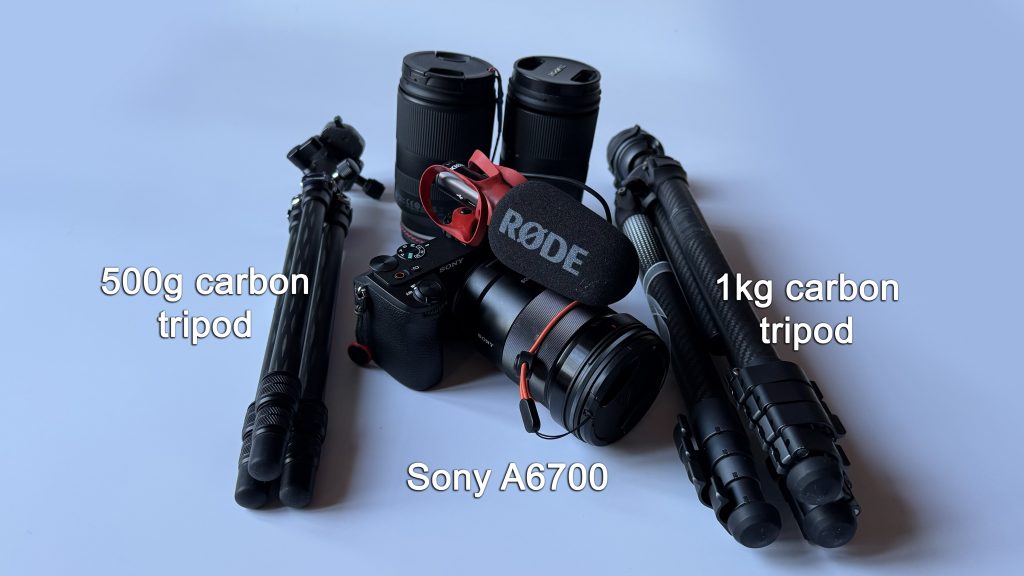
In the end I bought a Sony A6700 body. Sony is, in my opinion, really leading the field when it comes to video, and the A6700 is the perfect body for my needs.
Being an APS-C body, it’s small and light, and yet despite it not being a full frame “pro” body, Sony, for whatever reason, packed some really professional video capability into it that its other APS-C bodies lack, like 10-bit 4:2:2 colour, dual native ISO, S-Log3, 5-axis IBIS, and Sony’s reknowned autofocus system (although I do actually shoot a lot with manual focus too).
The other advantage of using an APS-C body is the plethora of much cheaper lenses available, especially lenses that have significantly longer zoom ranges than those for full frame bodies, and the lenses I use are the Sony PZ 18-105mm f/4, the Tamron 17-70mm f2.8, and a Tamron 18-300mm f/3.5-6.3; the latter here is the lens that I use the most during the day on hiking trips, switching to the 17-70mm once I am pitched and the light is fading. I do prefer constant aperture lenses because there’s less faffing when changing focal length, but I always shoot with a variable ND filter that often needs some adjustment between shots anyway so it’s not too bad to deal with.
Depending on where I am hiking, and whether or not I expect to see much wildlife, I will sometimes use the Sony 18-105mm lens instead of the Tamron 18-350mm. In fact, the Sony 18-105mm is actually such a versatile lens that if you only had the budget for one lens, it would probably be a top choice; especially when paired with dual native ISO, the slower F4 aperture can actually still be used for night time shooting (and a bit of noise reduction in post).
The A6700 also has pretty good weather sealing. I’ve had it out in hours and hours of rain without problems. I’ve recently bought a Rode VideoMic Go II shotgun mic for sound and also occasionally use a DJI Mic Mini II with the camera.
Without wishing to sound conceited, it’s my constant use of my A6700 and these lenses which has, I feel, given my videos a distinctive feel, especially my use of different focal lengths and large apertures. While this may appear a deliberate attempt to make my own work “feel different” to most other outdoor Youtube channels, and maybe on some level it is, mostly it’s because it’s simply an intuitive way to shoot for someone coming from a photographic background.
Many Youtubers learn photography/videography with an action camera, which is so fundamentally different because it’s very much point-and-shoot. And I know I said earlier that cameras don’t really matter that much, because you can shoot a video on any camera with video capability, but I love the creativity of different lenses, focal lengths and apertures. I love using depth of field as a compositional aid, and using telephoto as a way of visually compressing the environment. It allows me to sort of bring the environment in closer around me, which makes the video feel more immersive.
The word “cinematic” has become such a tedious cliché, especially as so many people think it’s a certain way of colour grading or it’s down to specific settings in your camera. While some things, like natural motion blur, can make your video look a bit more like a professional film, whether or not something truly feels cinematic is more about intention. What are you trying to convey? How do you want people to feel when watching your film? These are things that influence certain decisions I make when I am out shooting. And I am by no means an expert; I am very much still learning all of this.
I also shoot quite a lot with my phone, an iPhone 16 Pro. I have a special case for it that I can attach ND filters to (since the phone has a fixed aperture, an ND filter is needed for achieving motion blur), and I generally always shoot using the Blackmagic app, which allows you to more easily adjust your ISO and lens settings manually. The video quality of modern smartphones is actually really good; they’re a bit limited in terms of detail and low light because of their small sensors, but for shooting in daylight they’re a convenient option and I use mine quite a lot when shooting kayaking videos, as my phone is always in the pocket on my buoyancy aid. It’s a very handy tool, although I do find the fixed aperture and the lack of camera ergonomics (eg having specific physical dials/buttons to adjust settings) frustrating. I shot my film of kayaking around Lismore and Shuna entirely on my iPhone and two GoPros.
For the type of shooting I do on land, a tripod is pretty essential, and I have two main ones. One very compact one, a Cullman Carvao 816TC, which weighs around 500g. I loved the compact size of this and the very light weight and used it extensively last year, for example on my Affric Kintail Way hike. The drawback to it is that it’s not very high, so I would generally have to avoid shooting closeups of myself walking near the camera, because I’d always be standing somewhat above it; this was avoided by always being midframe, but it was limiting.
The larger tripod is a Neewer Litetrip LT32. It’s basically a Chinese attempt at producing something similar to the Peak Design Travel Tripod. This one extends to head height but that comes at the weight penalty of an additional 500g and quite a lot more bulk. Not a problem on kayaking trips, but certainly a noticeable additional item for hiking. But so far I have been quite happy with it. I particularly like the head on it, which is really quick to adjust and has a nice quick release plate.
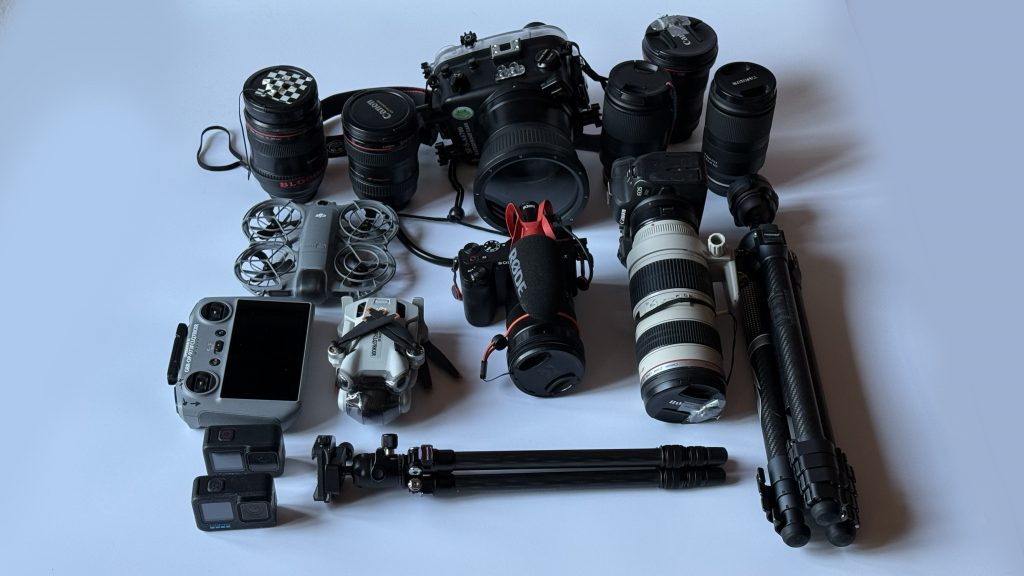
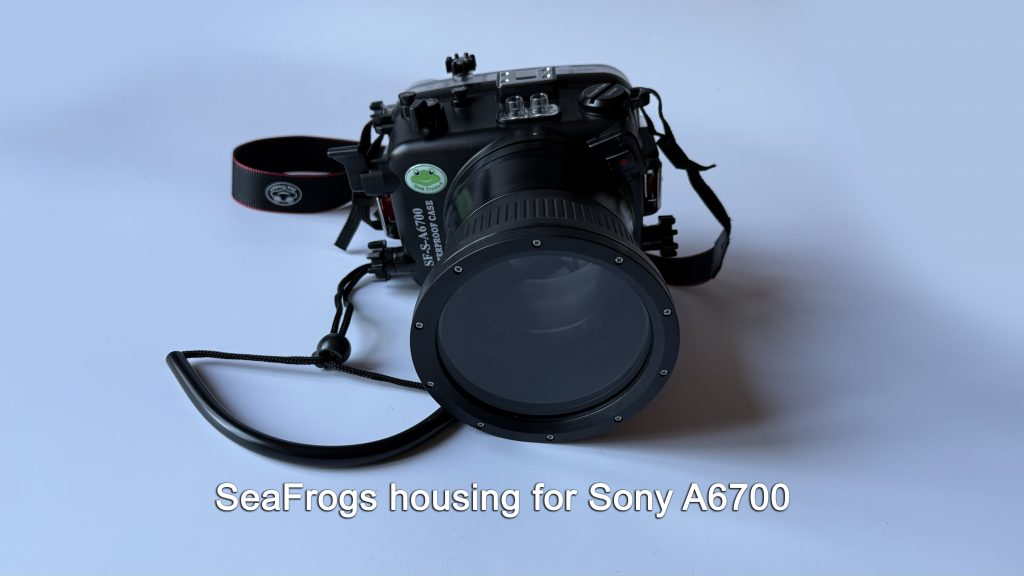
I also have a SeaFrogs underwater housing for the Sony with the 18-105mm. This is a budget housing as I was not willing to invest £2000 for a high end dive housing for shooting kayaking stuff. The housing is very bulky though, so I only use it for certain things like detail shots or when I am shooting for other people; it’s too bulky to bring on expeditions. I am currently experimenting with a different method of protecting my gear on the water, using an American product called Outex. I will see how well these work before reporting anything further on them!
Drone-wise, I have been using a DJI Mini 4 Pro for a year or so now, having upgraded from a DJI Mini 2 that I had previously. The Mini 4 Pro is a really great drone for a sub 250g model, and my main reason for upgrading was to be able to utilise DJI’s DLog M colour science. Whilst it could be argued that DLog isn’t a true log profile, it does give me a lot to play with.
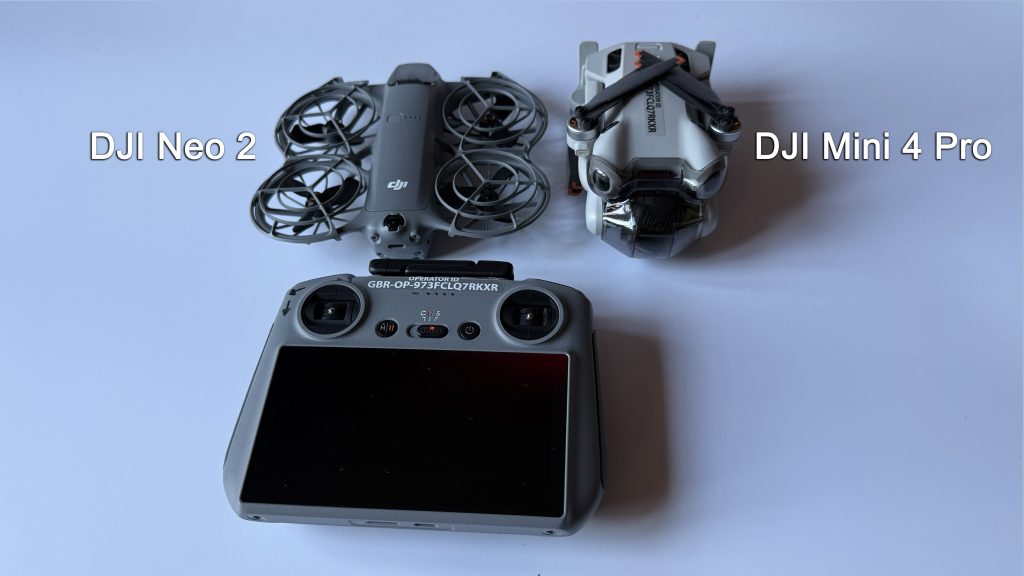
Being so small and light, this drone always comes with on hiking trips. I use it with a set of ND filters to maintain the “180º shutter rule” when shooting, to ensure the footage has natural motion blur. As such, this means I always shoot with it fully manual, setting my exposure for each shot. Because of my background in photography, this feels natural and intuitive.
I also recently, hesitantly, bought a DJI Neo 2. For me, personally, the video quality is not great, but I don’t mind launching it from my kayak to just get a few shots here and there. The 8-bit footage has quite a lot of internal processing that makes it, in my opinion, not very nice looking and very inflexible in post, but I have created a Davinci LUT to sort of “fix” it somewhat and help to blend it, as seamlessly as possible, with my footage from my other cameras. I also generally will only use it in overcast conditions, as it doesn’t handle high dynamic range well, and cannot be flown using manual exposure without a dedicated controller, which I don’t want to use when I am in my kayak. I am eagerly waiting to see how Hoverair’s new Aqua drone does when it’s more widely available, as that could be a real gamechanger (I hate the term gamechanger because it’s so overused these days but it’s applicable in this instance).
Lastly, I use two GoPros on my kayak. I have another article about how I set these up on my kayak here. I mentioned earlier that I don’t actually particularly like GoPros, but use them out of necessity; this is because, in an unforgiving environment like the sea or other bodies of water, action cameras like GoPros are a safe bet. But that waterproofness and durability comes at the expense of optic versatility; I find myself constantly frustated by their extreme wide views. I just don’t particularly like the aesthetic, especially the way they tend to visually “push back” the environment around me, making everything appear further away than it is. There’s a time and place for wide angle, but I don’t like it being the only option. One of my favourite things about shooting hiking videos instead of kayaking videos is that I don’t have to use GoPros!
Nerdy Stuff
Just a few bits of info that others might find interesting…
I shoot entirely in log colour on all my cameras, except the DJI Neo 2 which doesn’t have log colour. If you feel comfortable working with colour grading, give log a try!
I edit and colour grade in Davinci Resolve Studio. Davinci feels like a piece of software I could use for ten years and still only have barely scratched the surface. I find it endlessly fascinating.
I have my own LUT that I have made, which I tend to apply to all my videos these days. It’s gives them that distinctive, slightly dark look with soft specular rolloff and soft blacks, that’s pushed slightly cooler on the spectrum. It’s perhaps a little ironic that I use a Sony camera but grade my footage to look more like Kodak film stock.
I dislike 360 cameras. I actually own one – the DJI Osmo 360. I’ve used it (and some of the Insta X series 360 cameras) at music festivals to shoot crowd shots from the photo pit at the front, but I dislike the additional step of having to run the footage through proprietary software, and I personally find the very wide FOV very limiting for my particular video style.
I use a Rode NT USB+ mic for voiceovers that I record in Garage Band on my Mac.