Setting Up Cameras On A Kayak
I get so many people contacting me to ask about my camera setups when I am out shooting kayaking films, so I made the short video alongside outlining the cameras I tend to use, and how I mount them on my boat.
But here’s a bit more in depth information.
As shown in the video, my main camera is my stern-mounted GoPro Hero 12. This uses a mount from a company called Kayalu in the States. Specifically, this is the mount: RAM Mounts Locking Suction Camera Mount for GoPro® Hero with Toughbar. As the name suggests, this mount uses parts from the manufacturer RAM Mounts, with an additional “Toughbar” with a GoPro mount at the end of it. This mount is well articulated and sticks very well to the smooth gelcoat on composite kayaks. It can also stick to smooth areas of plastic kayaks, but not rough textured plastic.
The mount has a pre-attached cord with a carabiner, and I also always use an additional carabiner on a line directly connected to the GoPro itself for extra security. Having said that, the mount’s suction cup has yet to ever unexpectedly or accidentally come off my kayak, even when it’s taken a knock.
As I obviously cannot reach this camera while I am paddling, I operate this stern-mounted GoPro with a remote control. I use GoPro’s own official remote for this.
On my deck, directly in front of my cockpit I have a GoPro Hero 11. This is usually mounted on a highly articulated Gorillapod tripod that I can easily keep in place under my deck bungees, however I also occasionally use a suction mount for this one. You can see the Gorillapod setup in the photo below.
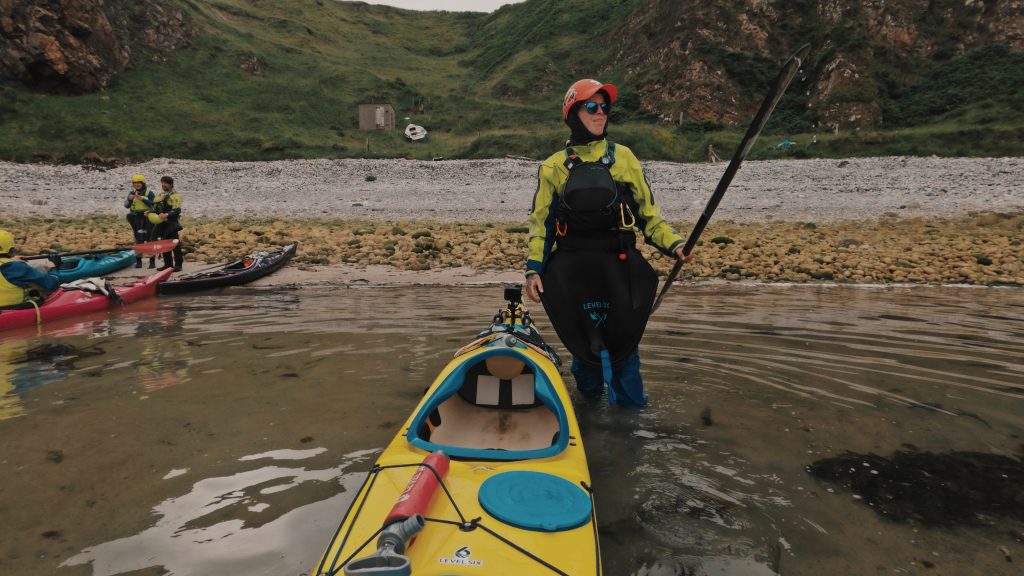
I have this GoPro attached to a small swivel attachment between it and the tripod; this allows me to quickly swivel the GoPro to the sides, forward or facing back towards me, to get different views. This is why I keep this GoPro directly in front of me, so that I can easily change the view.
Like the stern-mounted one, I also tether this GoPro to my decklines using a carabiner.
GoPro Film and Lens settings
When filming, I tend to film in 10-bit flat/LOG colour profiles, as I prefer to colour grade my footage as opposed to using the in-camera colour processing, which I don’t personally like. This is an additional step and I appreciate not everyone has the time nor inclination to faff around with their footage beyond editing it, but personally I am conceited enough to want my footage to have a particular “look” to it and am happy to spend time in Davinci Resolve colour grading.
Crucially, I also shoot using the Linear+ lens; this keeps the horizon level at all times by cropping slightly into the frame. I have a strong preference for this, even though you lose a small amount of resolution, because I can find it disorienting watching footage without strong stabilisation for extended periods. I’ll sometimes deactivate this when shooting whitewater kayaking, as you get a bit more feel for the rapids without it, but for sea kayaking, I much prefer to have this gimbal-like look to the footage. I’ve been using this setting for a few years now and have found that it works really well most of the time, only very occasionally skewing the horizon for brief periods.
Other Cameras
In addition to my GoPros, I also shoot a lot with my iPhone 16 Pro on the water. I keep it in my buoyancy aid pocket so that it’s close at hand to pull out and film when I am stable enough to be able to do so. I do not use any waterproof case for this as they significantly reduce the quality of the optics. I’ve dropped my phone into the water many times and have never had any issues because of it, apart from occasionally getting a bit of water into the charging port, which is resolved by keeping the phone upright in a dry area for a few hours before attempting to charge it.
I tend to use an ND filter on my phone which attaches to the case using a Smallrig filter holder, and I usually shoot using the Blackmagic iOS app. The ND filter allows me to get the right exposure for maintaining natural motion blur, which is something I personally like.
I also occasionally take my Sony A6700 mirrorless camera on the water in a waterproof housing, and am actually increasingly doing this going forward, as the Sony is my main camera for video work.
Lastly, I use a DJI Mini 4 Pro drone. I don’t tend to fly this while on the water though, preferring instead to land when I can and launch it and fly it from beaches or other stopping points. I’ve had issues landing the drone on steep beaches and rocks though, so tend to bring a fold out landing pad for it. This also provides a bit of protection from the environment for it during take off and landing.
Very occasionally I’ll launch it and then get back into my kayak, attaching the controller to myself and carefully using it from the water, but I prefer not to do this as the controller is not waterproof and I’d be concerned about the inability to land the drone again if the controller got damaged. I’m eagerly awaiting the release of a decent quality waterproof drone to solve this issue!
Let me know below if you have any questions at all.
One response to “Setting Up Cameras On A Kayak”
-
[…] Lastly, I use two GoPros on my kayak. I have another article about how I set these up on my kayak here. […]




Leave a Reply